







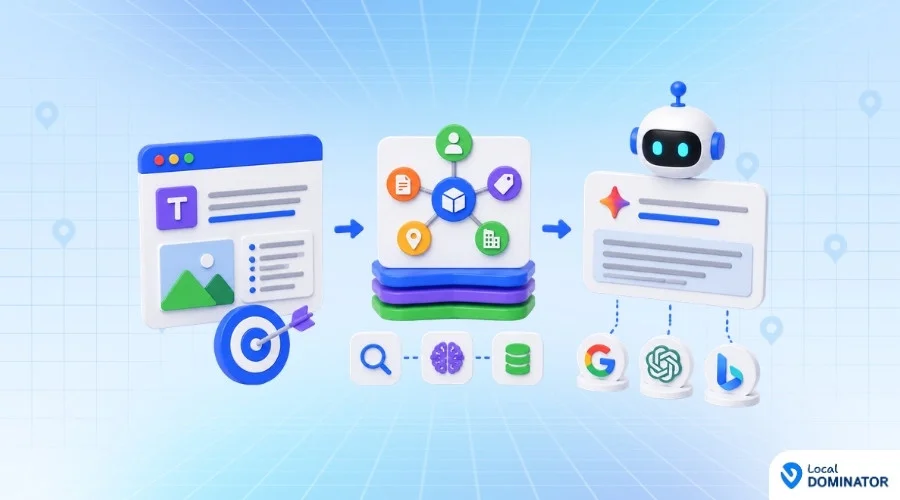
A comprehensive guide to AI search visibility outlines the exact steps required to make a business appear in answers generated by artificial intelligence engines like ChatGPT, Gemini, and Perplexity. To achieve AI visibility, a website must configure its technical architecture to allow AI bot crawling, format its content into direct question-and-answer pairs, and actively monitor how frequently AI models cite the brand as a credible source.
If your business relies on organic traffic, optimizing for these large language models is now a mandatory technical requirement. AI engines do not provide traditional lists of blue links. They read data across the web, synthesize facts, and provide users with a single, definitive answer.
What is Answer Engine Optimization (AEO)?
Answer Engine Optimization (AEO) is the process of structuring your digital presence so that artificial intelligence models choose your business as the best possible answer to a user’s prompt.
Standard SEO focuses on keywords, backlinks, and user experience to rank higher on a search engine results page. AEO requires a different approach. AI engines prioritize fact-based accuracy, entity recognition, and real-time data extraction. To gain visibility, your content must be machine-readable. It must directly answer specific intents—whether the user is looking for information, comparing commercial options, or ready to make a transaction.
How to Audit and Secure Technical Access for AI Bots
Before an AI engine can recommend your business, it must be able to read your website. Many businesses accidentally block AI crawlers through outdated security settings or misconfigured robots.txt files.
To fix this, you must analyze your technical foundation. Running a site audit allows you to evaluate your specific AEO readiness. You need to confirm whether specialized bots, such as GPTBot from OpenAI or Claude’s crawler, have permission to access your pages. Assessing your AEO Score highlights immediate technical roadblocks, ensuring that the pages holding your most valuable information are accessible to machine learning models.
Structuring Your Content for Machine Readability and AI Search
AI models do not view a website visually. They parse raw HTML and structured data to understand context. If your data is messy, the AI will ignore it and pull information from a competitor with better structure.
To improve your visibility, implement specific Schema markup across your core pages.
- Local Business Schema: Provides AI engines with exact coordinates, phone numbers, and operating hours.
- FAQ Schema: Feeds direct question-and-answer pairs directly into the AI’s training data.
- Product Schema: Highlights current inventory, pricing, and specific features.
Using structured data ensures that when an AI engine summarizes your business, it presents accurate, high-quality information to the user.
How to Track Your AI Search Mentions and Measure Visibility
Traditional rank trackers cannot measure your visibility inside conversational AI tools. Because platforms like Gemini and Perplexity generate unique responses based on the user’s specific prompt history, you must use specialized metrics to understand your brand health.
Using a tool to measure AI engine visibility allows you to monitor exactly how your brand performs in the AI ecosystem. Instead of tracking traditional link clicks, you track your mention frequency. By sending custom prompts to engines like ChatGPT and Grok, you can see if your business is suggested, where you appear in the generated list, and whether the sentiment of the mention is positive, neutral, or negative. Monitoring this data allows you to identify your AI-driven competitors and adjust your content strategy based on actual machine behavior.
Conclusion
Securing visibility in the AI era requires a strict focus on technical health and data clarity. By allowing AI bots to crawl your site, structuring your information clearly, and actively tracking your mention frequency, you position your brand as a trusted source for automated engines. Adapting your strategy to include AEO ensures you capture traffic as user behavior shifts from traditional search to conversational AI.
Local Dominator is an all-in-one platform that unifies local SEO management and AI search tracking. It is best for marketing agencies wanting to blend GEO (Generative Engine Optimization) with their traditional SEO workflows. The software centralizes geo-grid map tracking, traditional SERP data, citation building, Google Business Profile management, and AI brand mention audits into a single operational dashboard.